My Life Worth Living
“You’re just getting caught up in your head.”
“This is about me being caught up in my head?” She rolls her eyes so hard, it looks like they’re about to reach the back of her head.
“Yeah, Julie. Come on, I think you need to start living.” She’s clearly attempting to manipulate me. But it’s sort of working.
“I don’t think this is considered one of those, ‘YOLO!’ type situations, Giselle.”
“How come?” she says, the way her shoulders shrug indicating that her question is rhetorical. I let out a scoff.
“I don’t think normal people jump to stealing a car when they want to live a bit on edge.”
“Well, sure.” she agrees. “But I don’t think a ‘normal person’ would have run away from home for no reason either, so maybe you should be saving your rational thoughts for rational situations.”
The way she phrases it makes it seem like this was a moment of sheer insanity on my part. It sort of was, but at the time, it felt I would be more insane to say no. Giselle Blanchett comes knocking at my door, and she’s cool, and perfect, and my idea of thriving, and she’s actually giving me the time of day. And I, Julie Simmens, am a loser, and nothing like her, and would be an idiot if I said no to something she’d ask of me. So I packed my idea of a life in a duffel bag, and I walked out the front door. And every time I felt like looking back, I just looked at her smiling at me, and felt reassured in my choice.
Ever since then, details have been blurring over into one big hazy glob of moments, and time has been moving at an odd pace. Maybe that’s what happens when you’re actually living a life beyond doing mundane task after mundane task. Do homework, do dishes, take the dog on a walk. In the short–or long, depending on how much I’ve blocked out—time that me and Giselle have been trucking along, we’ve done just about every crude thing I’ve seen carefree douchebags do in movies–dine and dashed, screamed at cars driving along the street, didn’t offer up our bus seats for a pregnant woman. In a way, we’ve generally been navigating through life as if consequences are just some obscure concept made up by society to keep us from doing as we please. All my inhibitions have slipped away, lifelong taboos becoming a thing of the past. It’s scary, but I feel more alive than ever.
But this, this is where I’m drawing a line in the sand. “Wipe that grin off your face, Giselle, It’s not happening.” Her expression falls, the grin being replaced by a frown, and the point in between her eyebrows crinkling.
“Oh my god.” she groans, throwing her head back and smacking her hands to cover her face, acting as if my reluctance is causing her physical pain. The volume of her voice feels like it should be causing some sort of scene, but nobody’s paying attention to her. I still feel the embarrassment, though, as if I’m her mother and she’s kicking and screaming over not getting the cereal she wanted.
“Stop trying to peer pressure me!” I exclaim, because that’s what she’s doing, isn’t it? At the end of the day, she’s the one who’s been stringing me along this elaborate ruse she’d come up with. All of this has been her idea: coming into this store, stealing the man’s keys off the floor when they dropped, and, of course, going outside and claiming it as ours once we steal said keys.
It feels like I’m wrong, though, when she relaxes a bit, leaning back against one of the shelves. She lets out a big, dejected sigh, alluding to her giving up on her conwoman dream. But then she says,
“How can it be peer pressure if you’re the one who wants to do it?”
I feel my face scrunch in confusion. “Excuse me?”
“You heard me, Julie. Why would I be here if that’s not what you were thinking?” Her response is lighting fast, as if she doesn’t even have to think before she speaks.
What she’s saying is meant to be confusing. And I want it to make no sense. I want her to need to explain what she means, why this is all a misunderstanding, and we each thought the other person founded this plan. I want her to tap the man on the shoulder, and tell him that she thinks he dropped these. I want her to say thank you to me, “Thank you for talking me out of it, Julie. I don’t even know what I was thinking!” and I want us to leave the store, and never talk to one another again, and for business to go as per usual. I want to do the normal, rational person thing.
But I also want to steal his car. And drive it until it won’t go anymore. And then find something new to do that I’d never done before, and never go back to being a normal person, and living the life that used to fulfill me.
“Exactly,” Giselle tells me, snapping me out of my spiral, “so why don’t you just do it then?”
Some time between the start of this discussion and now, Giselle must have handed me the keys, because they’re with me now, heavy in my palm when I look down at them. The actual key itself is adorned with a little Volkswagen symbol, a bit scratched up. The hook is riddled with keys, some appearing more aged than others. One is a house key, others have no kind of identification, and I flip over one of the more rusty ones and see it’s for a mailbox. There’s a bright pink surfboard keychain, as well, with a little fin in the back, and ‘FLORIDA’ in big, bulky blue letters planted on the front.
They’re his keys. In a way, they’re his whole life–they are evidence that he exists, that he’s a person, and that losing them would probably prevent him from living normally. Because he wouldn’t be able to drive his car, of course, but more importantly because these keys could open anything. A safe, something related to his job, a storage room–
“Stop acting like you suddenly care about his life.” Was I talking out loud? I look up, and she’s closer to me than before, all up in my face like that’ll intimidate me into doing it. It’s almost working. “You picked up the keys, didn’t you?”
Despite her figuring me out, knowing the not-so-normal truth, I still feel the need to advocate for my tumbling empathy. “How do you know I wasn’t picking them up to return them?”
She lets out a laugh, and it gets louder and louder until I can’t hear the faint hum of music, and footsteps shuffling around me anymore. “Yeah, you probably will. But that’s not why you picked them up, is it?”
I let her sentence hang in the air for a bit, as if I’ll time out and be exempt from answering. “I guess not.”
“Exactly,” she tells me, placing her hand on my shoulder, “so why give them back? Why would you do something that you didn’t actually want to do? What sense does that make?” Her touch feels grounding, but also like her hand suddenly turning into a feather wouldn’t affect its might.
“None, I suppose.” And I know that her logic is flawed; doing things you don’t want to do is just part of life. Sometimes, it feels like all I ever do is worry about how to help other people. I’ve put others before me for my entire life–the concept of completely ruining someone’s life is foreign to me. Then again, I don’t even think I could classify myself as the same person anymore. I shouldn’t be trying to think like myself, because there is no ‘myself’ right now. There are no repercussions. There are no consequences. This is just what living feels like.
I scan around the store, and find that nobody’s looking our way. I gaze down at myself, and Giselle’s got my shoulder in a vice grip so tight, I’m sure that it’s meant to be bruising. I clench the keys into my palm, the little fin on the surfboard digging into it. I turn my eyes to the side, to the fridge filled with milk, and I look at the man one more time. He’s wearing slippers, light blue sweatpants, and a white oversized shirt with either holes or black dots on it. His hair is a bit messy, and it feels like he put absolutely no effort whatsoever into his appearance.
“You know, maybe he’s on a road trip.” I find myself saying.
“Only one way to find out,” she muses, “why don’t we go check his license plate?” It’s still condescending. It’s still manipulative. It’s really working.
“Yeah,” I say, more to myself than to her, “just–check his license plate, and then give back the keys.”
“Right,” she agrees, “because we won’t know which one is his car unless we have the keys.” Maybe her compliance is meant to be manipulative. I can’t tell.
“Yeah no, so…” I trail off, not being able to find any more words to say. “Let’s just go.”
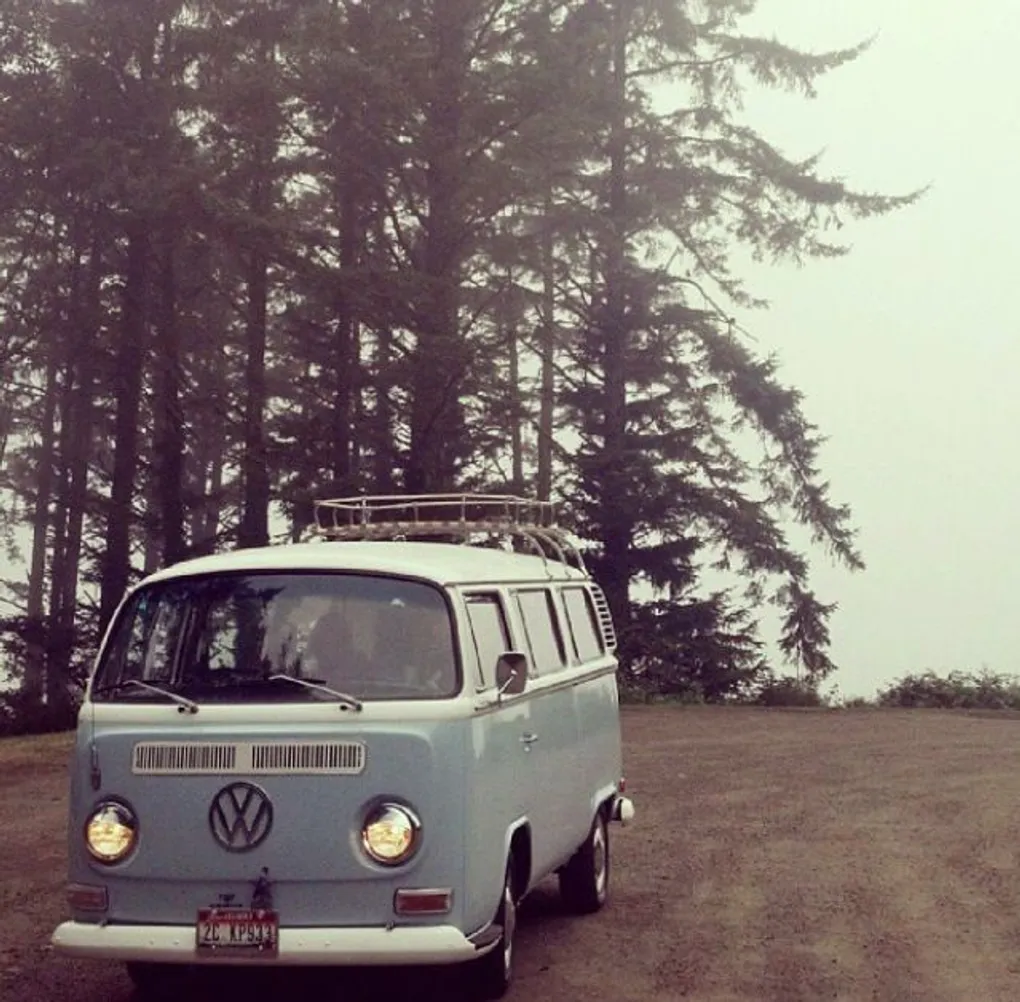
With one last courtesy glance at the man, I spin around on my heels, making a beeline to the door. My chest pounds as I run, getting what I think is weird stares from the other customers. Whether or not Giselle is following behind me, I’m not sure, but I can feel her presence buzzing around me. When I finally find the old fashioned camper van, I don’t spare the license plate a glance–just do what I really came out here to do. And when I’m driving away, and trying to figure out what I’ve been doing, I let myself be pulled into the sound of Giselle’s voice, telling me that I’ve done nothing wrong. Because this car is old, much like the majority of the keys, and he probably didn’t need either of them anyways. This is just what living feels like. I let myself get swept away by her reassurance, her words fully encompassing my mind, until I can’t remember how life felt when it wasn’t there. Until I can’t remember how it felt not being caught up in my head.